|


China : Jiāngsū Shěng
5.9 km (3.7 miles) S of Fentou, Jiāngsū, China
Approx. altitude: 73 m
(239 ft)
([?] maps: Google MapQuest OpenStreetMap ConfluenceNavigator)
Antipode: 32°S 61°W
Accuracy: 478 m (522 yd)
Quality: good
Click on any of the images for the full-sized picture.
| 32°N 119°E (visit #6) | (incomplete) |
![Visit #4: [01-Jul-10]](/cn/all/n32e119v4/preview.jpg "Visit #4: [01-Jul-10]")
![Visit #3: [21-Feb-06]](/cn/all/n32e119v3/preview.jpg "Visit #3: [21-Feb-06]")
![Visit #2: [31-Jul-04]](/cn/all/n32e119v2/preview.jpg "Visit #2: [31-Jul-04]")
![Visit #1: [23-Jul-04]](/cn/all/n32e119/preview.jpg "Visit #1: [23-Jul-04]")
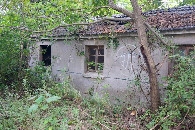
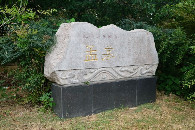
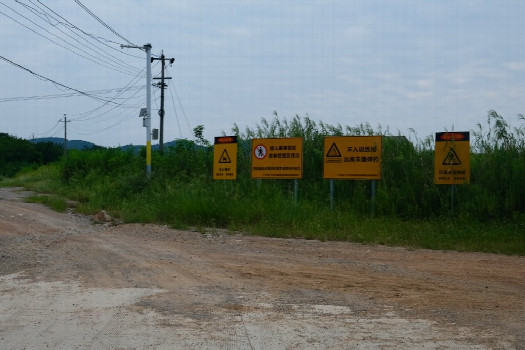 (visited by Nathan Mifsud and Trina) 21-Sep-2025 -- Apart from 34°N 118°E last year, none of the other eight confluences in Jiāngsū (江苏省) seemed to have been revisited since Targ Parsons and Zifeng Liu’s tour of the province back in 2010. I assumed that many had changed dramatically over the past fifteen years, but a glance at the satellite imagery of 32°N 119°E suggested that it was still surrounded by farmland and fish ponds. I thought it was worth visiting if only as a change of pace from the rest of my time in nearby Nánjīng (南京). It’d also be a simple introduction to confluence hunting for Trina, who confessed that she did not understand its appeal. As it turned out, our trip was not wholly enjoyable, partly because we failed to reach the confluence itself, and partly because of the reason for that failure being that it is now located in a live-fire training area (实弹演训区域), and we were observed at the threshold of the military zone. Initially, the journey was as easy as could be imagined. The metro system now comes within six kilometres of the confluence as the crow flies. We boarded at Xīnjiēkǒu (新街口) and changed at Mǎqún (马群) to the S6 line that opened in 2021. Hundreds of residential towers slid past our window and gradually gave way to farmland that was being sliced up by highways and sweeping overpasses: one four-lane road terminated abruptly at the edge of a paddy field. The new metro line curved to avoid the hills of Tāngshān (汤山), where half-million-year-old hominid fossils were discovered in 1993. A water park unfurled across the base of the mountain range, its immense car park deserted and all of its rides drained – a forlorn sight on a summer weekend. We alighted at Quándūdàjiē (泉都大街) and rode an escalator to the surface, where the gutters were unmarked and the lane-separating trees still young. By a fluke of timing, we walked directly onto a bus and soon found ourselves at the entrance to Mèngmù (孟幕), a rural community, almost deserted on a Sunday afternoon. The whole trip had cost just 9 yuan, leaving us a half-hour walk from the point. The first few turns were aligned to the cardinal directions, so as we walked west, north along a river, and west again, we watched the nearing of longitude and latitude to the desired integers. The sky was cloudy with patches of blue. We passed a furniture factory, a service facility for retired military, and then a mostly shuttered line of shopfronts, with clothes drying on makeshift lines between street trees and poles. We turned onto a lane that led us past small plots of corn, soy, long eggplants, chives, silk melon, taro, bok choy, chillies, and lotus, being tended here and there by farmers who looked our way. One silver-haired woman threshed a harvest spread along the pavement, the wooden swipple of her flail rotating and striking in rhythmic movements. We missed a turn because I mistakenly referred to Google Maps, which suffers from the GCJ-02/WGS-84 shift problem, rather than Apple Maps. I suggested we continue on a longer route rather than retrace our steps – there was a road ahead that seemed to be lined with factories we could pass through. But instead we encountered a boom barrier, monitoring camera, scanning stand, and army vehicles in sight further up the road. A squat grey building rose above the trees. We obeyed the signage and turned back. Our route then took us through a residential area that was a mixture of old and new, from the buildings to the cars, which even included electric BMWs and Audis. The passage was narrow. We walked through a talkative group of old men who squatted or sat on tiny chairs. Further into the village, a man was using a bucket to scavenge a pit latrine right by the lane. Soon enough, the space on either side opened up with well-tended farm plots bathed in late-afternoon gold. After about 200 metres, the plots were replaced by forest, with a few abandoned buildings that had characters scrawled on their sides in white. Only later did I look up their meaning: 军 (army), 产 (property) and 拆 (demolish). There was a paper sign taped to a rusted gate. Google Translate informed me: “Stopping is prohibited on the combat readiness channel.” Odd, I thought. I was slow to realise that this area must be a contiguous part of the military zone that stopped us earlier. It became clearer when we passed a building complex with two soldiers sitting just inside the gate, and two more jogging around a courtyard. They all turned and looked at us with, I imagine, some surprise. However, they didn’t say anything, so we kept going another few metres. A message I couldn’t understand was playing on loop, the volume growing louder and louder as we went up the lane until we stopped at an intersection near the source of the loudspeaker. The road had turned to dirt. The exact confluence was so close – just 478 metres away from where we stood at 31°59.777 N, 119°00.152 E. But while there was no physical barrier, it was clear that this was the end of our attempt. A camera with bright lights pointed at us, and both sides of the road featured an array of signs, including: 擅入军事禁区军事管理区违法 远离未爆弹药 / 珍爱生命 / 活离危险 Down the eastern road, within shouting distance, a man in fatigues was facing away from us herding goats. I suggested we go ask him if he might escort us to the point. Trina immediately spurned this idea – drawing further attention to ourselves was probably not the greatest move. So for the second time that afternoon we turned around. Past the barracks, the uniformed men looking at us again in silence. Back through the farm plots, the light fading, discussing on the way how likely it was that our faces had already been identified, and if so, whether it would lead to future scrutiny – perhaps not on this trip, but the next time we visit China. Probably not, but suffice to say, you might want to give this confluence a pass. |
| All pictures |
| #1: Some of the signs at the intersection where we stopped, facing north-west towards the confluence point. #2: One of the abandoned buildings along the “combat readiness channel”. #3: The marker for Mengmu near the bus stop. ALL: All pictures on one page |