|


United States : South Dakota
1.0 miles (1.7 km) WNW of Caputa, Pennington, SD, USA
Approx. altitude: 891 m
(2923 ft)
([?] maps: Google MapQuest OpenStreetMap topo aerial ConfluenceNavigator)
Antipode: 44°S 77°E
Accuracy: 3 m (9 ft)
Quality:
Click on any of the images for the full-sized picture.
| 44°N 103°W (visit #9) |
![Visit #8: [19-Jul-24]](/us/sd/n44w103v8/preview.jpg "Visit #8: [19-Jul-24]")
![Visit #7: [21-Aug-17]](/us/sd/n44w103v7/preview.jpg "Visit #7: [21-Aug-17]")
![Visit #6: [21-Jun-16]](/us/sd/n44w103v6/preview.jpg "Visit #6: [21-Jun-16]")
![Visit #5: [07-Jul-14]](/us/sd/n44w103v5/preview.jpg "Visit #5: [07-Jul-14]")
![Visit #4: [21-May-11]](/us/sd/n44w103v4/preview.jpg "Visit #4: [21-May-11]")
![Visit #3: [18-Jun-01]](/us/sd/n44w103v3/preview.jpg "Visit #3: [18-Jun-01]")
![Visit #1: [27-May-01]](/us/sd/n44w103/preview.jpg "Visit #1: [27-May-01]")
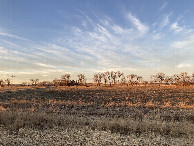
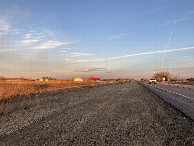
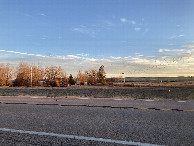
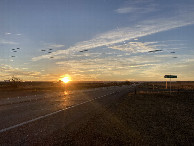
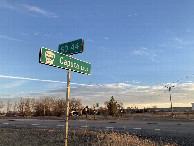
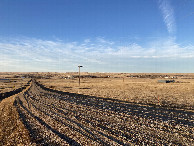
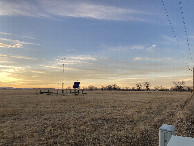
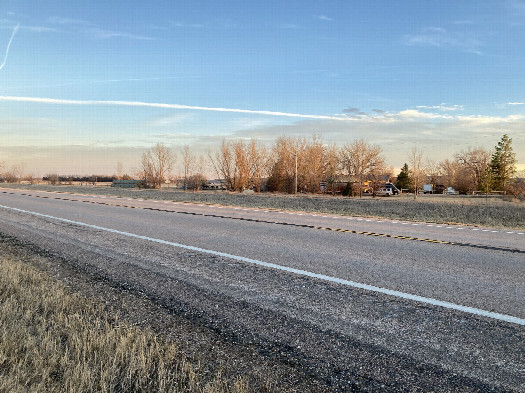 (visited by Michael G, Jack S and Emma Benedict) 19-Mar-2026 -- For the second March in a row (despite neither of us living there), Jack and I found ourselves exploring the widely varied landscapes of South Dakota. One year prior, we'd briefly detoured through Yankton SD after bagging 42N 97W and visiting a one-person Nebraska town called Monowi — we hadn't been to South Dakota before and weren't sure when the next opportunity would present itself. But life does funny things! Fast forward 364 days: Jack and Emma were on vacation in the Black Hills region, and I had enough time to join them (from North Dakota) for dinner and a hike. The other two spent their afternoon hiking in Badlands National Park, about an hour's drive southeast of the area's largest community, Rapid City. The three of us being confluence hunters, we were in luck: 44°N and 103°W happen to intersect on the direct route between the Badlands and Rapid City (in the westbound lane, in fact). Needless to say, it was easy deciding that evening's rendezvous point. While Jack and Emma explored the Badlands, I cruised across the vast and sparsely populated counties of northwest South Dakota. The landscape was gently rolling and dominated by grazing land, broken up only by a few picturesque river-carved valleys. With time I eventually spotted a distinct rise of mountains on the distant southwest horizon, the Black Hills. It was an unbelievably nice day for mid-March, the area completely snow-free as temperatures hovered in the mid-80s [~30°C]; in fact, today was the hottest March day in recorded history for much of the western United States. (For context, Rapid City's average high on March 19th is only 50°F/10°C.) Independent of the alarming implications for the still-dormant and dried out vegetation, this undoubtedly made the journey very relaxed and summer-like. Shortly before reaching the 103rd meridian while following SD 34 (still 36 mi/58 km north of the 44th parallel), I turned south onto New Underwood Road — oddly enough, no state or federal highways connect Meade and Pennington Counties except I-90, making it the fastest way to approach 44N 103W from the north. This road was very serviceable, and in one section crosses a pleasantly hilly section of land on either side of the Belle Fourche River. Just under an hour later I arrived at South Dakota State Highway 44, the long, narrow strip of pavement on which the confluence falls. I'd outrun the others by quite some time, leaving me to explore 44N 103W's immediate surroundings for a little while: the tiny hamlet of Caputa, and some rolling hills just south of the point. The former consists of a cluster of homes, post office, and bar/grill, roughly a mile [1.6 km] southeast of the confluence. I looked for a good place to leave my vehicle and walk around, but there unsurprisingly wasn't a town park nor really anywhere to walk around. Lacking a desire to loiter near the point on the corner of SD 44 and Caputa Loop, I opted to investigate the road leading south from the junction (Antelope Creek Road). In addition to the fact that it parallels the 103rd meridian within 100 meters for about 3 miles [5 km], this road offered a clear north-facing view over the confluence and Caputa vicinity (see photo) where it gradually sloped into some shallow hills just south of SD 44 — the quintessence of western South Dakota's high plains. Shortly thereafter I returned down to the junction, where Jack and Emma recently arrived. We parked opposite a weather station and exchanged greetings, on Caputa Loop about 100 meters northwest of 44N 103W. As we discovered after a quick internet search, said station is part of the South Dakota Mesonet; in effect, this confluence has the unique distinction of receiving 24/7 weather observations, perhaps making it one of the most well-observed in the world! (The site's page is linked here.) This point also has the (somewhat less unique) distinction of being unknowingly visited thousands of times per day, by virtue of its well documented drive-overable position. Interestingly, it also marks the only spot where Highway 44 actually crosses 44°N! With this esoteric trivia in mind, Jack and I wandered over to the highway shoulder to begin an almost comical back-and-forth dance of stepping out into the road with eyes fixed on the GPS, then retreating when cars approached (all the while trying not to appear stranded and/or confused). Once the longitude's location was settled, we opted to gather the directional photos from roadside. It was a mild and slightly breezy golden hour, as the low-hanging sun cast a warm orange-pinkish hue over the bare trees and highway-adjacent homes. Enjoying the late day warmth and reflecting on the luck of this spot having a Mesonet station, we waited a few minutes for a sufficient gap in traffic before finally securing all zeroes: we now briefly stood at 44N 103W, Jack's first South Dakota confluence, and our second visit along the 103rd meridian west! Though it was 7 PM, the temperature had only fallen into the low 70s [~22°C]; this was the most climatologically anomalous confluence visit that any of the three of us have done, to date. The sun slowly fell behind the Black Hills and we felt geographically satisfied, having spent almost 15 minutes near the spot. Thereafter we headed into Rapid City for dinner, finding further satisfaction in conversation over a much-needed meal at a local Nepali restaurant (called Kathmandu Momo House). The others had a tour of Wind Cave slated for the following morning, after which we'd all meet at a trailhead to hike South Dakota's highest point, Black Elk Peak. As I drove into the Black Hills that night, anticipation built for the coming day — before the hike, I planned to pursue Pennington County’s other confluence point. Given the record warmth, reaching 44N 104W (which lies near the heart of the mountain range) would likely be an impediment-free adventure! The story briefly continues here. |
| All pictures |
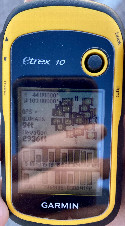
| #1: Looking southeast at 44N 103W, located in the middle foreground on the westbound lane of SD 44 #2: Looking north from the confluence #3: Looking east #4: Looking south #5: Looking west, towards an imminent sunset #6: Zeroes on the GPS! #7: Confluence junction at golden hour #8: Looking north from Antelope Creek Road, 1.5 mi/2.4 km south of 44N 103W #9: The Caputa weather station, just over 100 meters northwest of the confluence ALL: All pictures on one page |