|


United States : South Dakota
2.3 miles (3.7 km) WSW of Gettysburg, Potter, SD, USA
Approx. altitude: 629 m
(2063 ft)
([?] maps: Google MapQuest OpenStreetMap topo aerial ConfluenceNavigator)
Antipode: 45°S 80°E
Accuracy: 3 m (9 ft)
Quality:
Click on any of the images for the full-sized picture.
| 45°N 100°W (visit #3) |
![Visit #2: [04-Feb-04]](/us/sd/n45w100v2/preview.jpg "Visit #2: [04-Feb-04]")
![Visit #1: [19-Jun-01]](/us/sd/n45w100/preview.jpg "Visit #1: [19-Jun-01]")
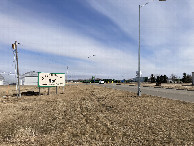
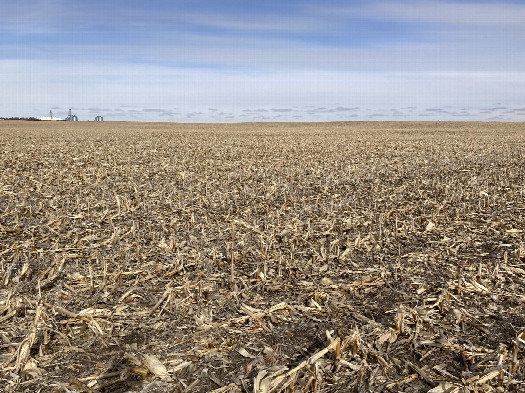 (visited by Michael G) 20-Feb-2026 -- 30th Annual International Confluence Day February 20th, 2026 marked exactly 30 years since Alex Jarrett and Peter Cline completed the Degree Confluence Project's inaugural visit, journeying over ten miles through the New Hampshire forest in search of a latitude/longitude integer degree intersection point. They were evidently trendsetters: over the following three decades, thousands more partook in the same avant-garde pursuit of places defined by wholly integer coordinates — often inconspicuous spots that can be precisely located using no more than five numbers and two letters. Veteran confluence hunter Woody Harrell appears to have christened February 20th International Confluence Day back in 2004, more or less establishing it as the designated DCP celebration day. Although it's still yet to be internationally (or nationally or locally) recognized, I felt compelled to observe the anniversary this year in the most appropriate way I knew how: a gratifying six hour round-trip to a presently dormant corn field, wherein an especially enticing latitude/longitude intersection exists — that of 45°N with 100°W. When I hit the road during the late morning, thermometers in central North Dakota hovered around 5°F [-15°C], made to feel extra comfortable by the northwest breeze. The preceding night had somehow been the coldest of February 2026 so far, a testament to the remarkably mild conditions of the last few weeks in the Dakotas. Luckily for me, whether it felt cold here (at ~47°N) didn't matter: I was heading to a warmer clime closer to the equator than the North Pole, north-central South Dakota. (At least physically closer, perhaps not spiritually.) Driving south along US 83, I discovered that this facetious framing held some truth today — past the state border, snow cover became thinner and thinner with each mile, disappearing altogether once I'd reached Potter County. Upon arriving at the junction with US 212, now just over 3 miles [5 km] away, I attempted to improvise a path to 45N 100W's nearest intersection (165th St and 308th Ave). Because the road network out here is predictably gridded and numbered, it's theoretically quite easy to navigate from place to place sans navigation apps. Unfortunately neither of my chosen routes yielded confluence access (305th and 306th Ave), so I returned to US 212 and drove into nearby Gettysburg. I'm glad I did — they have a top-tier (and educational) welcome sign, reminding visitors that the significant 1863 battle of the same name did not take place there (see photo). Funnily enough (and in direct contradiction with their own sign), I found that the Gettysburg school identified itself as the "Home of the Battlers". In all seriousness, a cool mascot idea! Meanwhile, I'd found a southbound road in town (310th Ave) that connected with 165th St — from there, the confluence was a couple minutes away. Anticipation built as I started westbound down 165th St toward 100°W. As Joseph Kerski discussed in his 2004 visit narrative, the latitude and longitude of this particular confluence each carry a larger importance of their own: 45°N, as a dividing line between the northern and southern half of the Northern Hemisphere (the mid-latitude of mid-laditudes, equally distant from the Arctic Circle and Tropic of Cancer), and 100°W, as an approximate boundary between the drier climates of the western United States (and southern Canada) and the wetter eastern half. In reality, the climatological and biogeographical transitions from "dry" to "wet" and "hot" to "cold" are very diffuse — much like any other confluence point, there wasn't a mind blowing view waiting there. But inasmuch as 45N 100W is a satisfying symbolic marker of those transition zones, I was excited to visit. I parked my car beside the confluence's field, a yellowish-brown plot of corn stubble. With it only 130 meters to the northeast and zero snow or ice, reaching the spot would be a (happily) trivial exercise. Outside of a few grain silos, there was little to see as I stepped between rows of old corn stalks. Much like its northern neighbor I'd visited last summer (46N 100W), this confluence lies on the cropland-covered expanse of the Missouri Coteau — the less rugged eastern half of the Missouri Plateau, smoothed over by long-gone glaciers. The GPS coordinates fast approached today's target reading under the open sky, and I briefly meandered around a slightly taller stalk before catching a glimpse of all zeroes. I'd reached 45N 100W, my second South Dakota confluence and 31st overall (on the project's 30th anniversary... a missed opportunity, perhaps)! Despite being at this symbolic transition point between west and east, the surroundings were distinctly more "east of the 100th meridian" in nature: acres of featureless corn fields, girdled by gravel roads and peppered with patches of trees beside farmhouses and grain silos. There was little movement or noise here, save for the occasional sound of passing cars on US 212, a little under a mile [1.5 km] north. The weather was calm and reasonably cold — about 15°F [-10°C], with the steady light breeze making it feel even a bit chillier. (I measured a wind chill temperature of -2°F/-19°C.) Although it was no warmer than Kerski's aforementioned visit (which was also in February), the photos wouldn't have suggested it! A mild early February had melted any existing snow cover, giving the area more of an early spring look (until the next snow, virtually an inevitability at some point between now and late April). My gloveless hands weren't fooled by the warm-looking view, and I started back to my vehicle after a few enjoyable minutes on-site. After backtracking through Gettysburg (and taking the opportunity to pull over and get a photo of the welcome sign, which I hadn't done on my way in), I started the journey back to North Dakota. On my way back, I crossed west over the Missouri River in Mobridge SD (located a county north of 45N 100W). Where 100°W is a continental-scale approximation of the west/east transition zone, the Missouri River is the clearest "actual" boundary in this area — west of the river, the landscape became hillier and more heavily devoted to cattle grazing. As nice as the confluence's vicinity had been, I was happy for the change of scenery and enjoyed the remainder of my retreat back to the colder side of the state border. Happy 30 years, Degree Confluence Project! |
| All pictures |
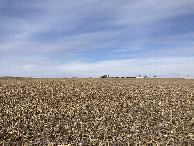
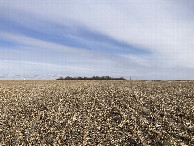
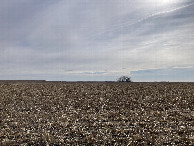
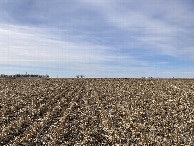
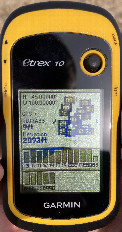
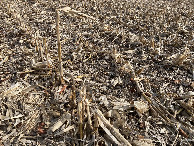
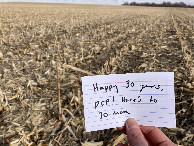
| #1: Looking northeast at 45N 100W, located beside the taller, bent stalk in the middle foreground #2: Looking north from the confluence #3: Looking east, toward the nearest farm home (behind the trees) #4: Looking south, toward the road #5: Looking west #6: Zeroes on the GPS! #7: Confluence corn stalk #8: Welcome to Gettysburg! (1.7 mi/2.8 km northeast of 45N 100W) #9: That's 360 months, one for each degree of longitude ALL: All pictures on one page |