|


China : Yúnnán Shěng
9.9 km (6.1 miles) NNW of Chuanjie, Yunnan, China
Approx. altitude: 1495 m
(4904 ft)
([?] maps: Google MapQuest OpenStreetMap ConfluenceNavigator)
Antipode: 25°S 78°W
Accuracy: 5 m (16 ft)
Quality: good
Click on any of the images for the full-sized picture.
| 25°N 102°E (visit #3) |
![Visit #2: [09-Jul-10]](/cn/all/n25e102v2/preview.jpg "Visit #2: [09-Jul-10]")
![Visit #1: [02-Sep-05]](/cn/all/n25e102/preview.jpg "Visit #1: [02-Sep-05]")
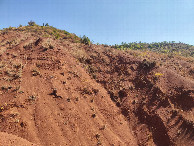
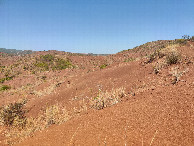
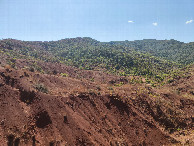
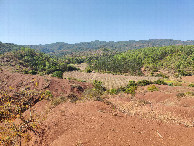
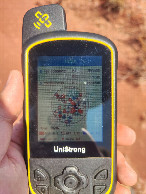
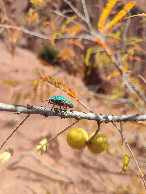
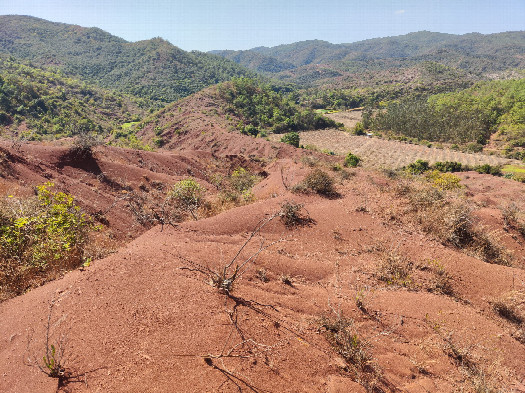 (visited by Xinhao Cheng) 21-Feb-2026 -- 25N 102E: Mountain Wind Across 200 Million Years Following the line of 25°N from 104°E to 102°E, the landscape shifts from the gentle, red-earth-covered limestone plateaus of Eastern Yunnan into the weathered, fragmented, and water-carved Jurassic Red Beds. This geological sequence, known as the Lufeng Formation (禄丰组), extends from Wuding (武定) and Anning (安宁) in the east to Chuxiong (楚雄) and Yuanmou (元谋) in the west. Historically, this area has served as the vital corridor connecting Kunming (昆明) to Western Yunnan. Traces of the Ancient Horse Road (滇西马路), the Burma Road (滇缅公路), the unfinished Yunnan-Burma Railway (滇缅铁路), and the Chengdu-Kunming Railway (成昆铁路), as well as modern national highways and high-speed rails, all converge through the narrow gaps of this shattered mountain terrain. In different eras, standing atop the ridges of Yanglaoshao (杨老哨), one sees undulating red ridges stretching toward the horizon—a vista that has likely remained unchanged in the eyes of westward travelers for millennia. These purple-red clastics are poorly permeable, leaving the ridges barren of dense forests, occupied only by scorched red earth, low grasses, and sparse shrubs. Yet, this same rock is incredibly fragile; under the lash of rain, it erodes rapidly into a labyrinth of deep gullies. The heart of this red world is Lufeng (禄丰), specifically the Dinosaur Mountain (恐龙山) area, famous for its wealth of Jurassic dinosaur fossils. Setting out from Kunming via the G56 Expressway (杭瑞高速), I exited at the Dinosaur Mountain site and turned onto a rural road running parallel to the highway. Ten kilometers later, the pavement ended at a village called Duwafang (独瓦房). The GPS indicated that 25°N 102°E lay 2.5 kilometers to the northwest, but in the mountains of Yunnan, linear distance is a mere abstraction. My route required a detour westward along a dirt track, rounding a mountain spur before turning north over a pass and following a valley. As the trail climbed, the valley below opened up, showing how various transport routes were compressed into the narrow space between two encroaching spurs. Beside me lay the exposed, shattered purple-red clastics—typical of the Jurassic Red Beds. In less weathered sections, parallel bands of deep purple, red, brown, and yellow were visible. These are inland lacustrine deposits from a time when this land had already risen above the sea. The colors encode ancient climate cycles: dark reds from hematite signify lake contraction and oxidation during arid spells, while pale yellows from limonite mark rain-abundant years. Walking over this "dead lake bed" felt like treading upon tens of millions of years of dry-wet cycles, my footsteps disturbing the ancient temporal order. The dry path seemed endless, the rock crushed by wheels into a fine purple dust that covered my feet. A local motorcyclist roared past, kicking up a miniature dust storm. As I neared the coordinates, the valley filled with farmland and scattered houses. It was the season for rapeseed blossoms; the high-saturation neon green and golden yellow clashed abruptly against the rock that appeared pale under the intense sunlight. Near a courtyard, a grey dog barked fiercely at me, while a silent, white dog watched with an unnerving stare. Feeling vulnerable, I armed myself with a fallen branch. After walking another few hundred meters, just as I had almost let my guard down, a figure suddenly darted out from the roadside! It was a yellow weasel. It was just as startled as I was; it paused for a split second, then swiftly crossed the road and vanished into the scrub on the opposite side. The vegetation revealed a mix of human-dispersed and natural species: Sisal, Euphorbia antiquorum (金刚纂), and the sacred Musella lasiocarpa (地涌金莲). Prickly pear cacti, carried by birds from the Americas, dotted the slopes. These plants made me wonder if this was a "Dry Dai" (旱傣) village, but a local elder informed me it was a Han settlement, and he was simply walking to the Xiaojie (小街) market five kilometers north. The GPS indicated that 25°N 102°E was drawing closer, situated just behind the ridge to my left. I was faced with a choice: continue north along the established path, round the mountain spur, and then swing southwest to approach from the foot of the mountain; or—the simpler but more direct option—scramble straight over the ridge and descend toward the destination. After some hesitation, I chose the latter. Parallel to a gully that extended toward the summit, I began my final ascent. In truth, there was no road here. The terrain consisted only of sparse Dodonaea viscosa (车桑子) or Osteomeles anthyllidifolia (石积) shrubs, weathered and fragmented rock crusts, and the omnipresent Stipa. It was the latter that had caused my initial hesitation: the seeds of this plant bear barbs that drill into fabric, sinking deeper with every movement, and can even pierce the skin. Consequently, I had to stop every few stretches to clear the needle-like seeds from my trousers and socks. Finally reaching the highest point, the view opened up—red mountains stretched endlessly under the intense light, and the valley below was deeper than the one I had come from. The spurs and gullies fanned out like the bristles of a broom; the target point was on one of those small branches, a mere hundred meters away. Those final hundred meters were exceptionally torturous. I descended along one spur, watching the readings drop, until only twenty meters remained. But the GPS pointed toward the opposite spur, parallel to the one I was on, separated by a deep gully. I had no choice but to climb back up to the junction where the two spurs branched out, then descend again. Finally, the distance dropped to 3 meters. I stood at the edge of the gully, unable to move further forward. This was my destination. To the west lay the valley, its farmlands, and the distant red peaks; to the east was the ridge I had crossed; to the north and south were the endlessly overlapping and bifurcating spurs and gullies. Right before me stood a Phyllanthus emblica (滇橄榄/余甘子) tree growing on the gully's edge. Most of its leaves had fallen, and the remaining few hung sparsely, while the branches were heavy with drooping fruit. A vibrantly colored Buprestid beetle (吉丁虫) perched on the tip of a branch, watching me warily and shifting its position as I moved. Clearly, I was the uninvited stranger, and it had already staked its claim. The travelogue should have ended there. However, as I was halfway back, I suddenly realized I had left my voice recorder behind at the 25°N 102°E point. Out of necessity, I gritted my teeth and retraced the entire grueling route. After another close-quarters struggle with the needle grass, I finally recovered the recorder. By then, it had recorded one hour and thirty-six minutes of the mountain wind—the silent breath of the Jurassic. |
| All pictures |
| #1: the general area #2: east view #3: north view #4: south view #5: west view #6: GPS view #7: the beetle ALL: All pictures on one page |