|


China : Yúnnán Shěng
6.8 km (4.2 miles) SSW of Huaxi, Yunnan, China
Approx. altitude: 1755 m
(5757 ft)
([?] maps: Google MapQuest OpenStreetMap ConfluenceNavigator)
Antipode: 24°S 77°W
Quality: good
Click on any of the images for the full-sized picture.
| 24°N 103°E |
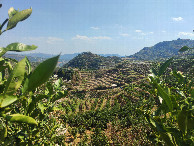
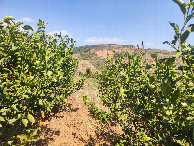
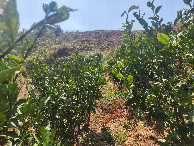
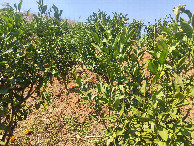
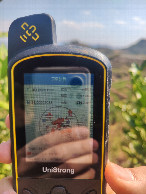
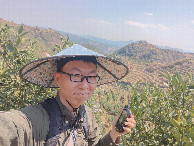
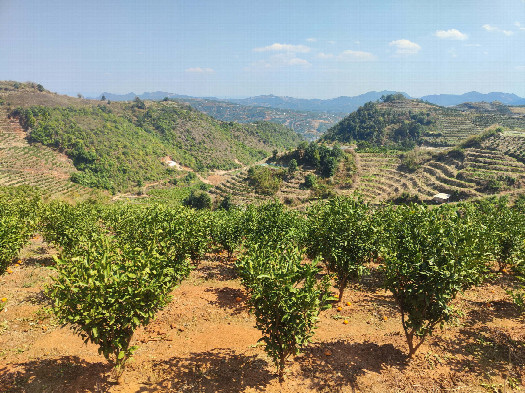 (visited by Xinhao Cheng) 16-Feb-2026 -- The Tangerine Orchard on the hillside: A Journey of Convergence This was my very first visit to a Degree Confluence point. Today is the Eve of the Chinese Lunar New Year—the final day of the Year of the Snake, with the Year of the Horse beginning tomorrow. I was heading back to my ancestral hometown in Yuxi for the holidays. A quick check of the satellite imagery revealed an unvisited confluence point nearby. It is situated in the mountainous region between Huaning County (Yuxi City) and Jianshui County (Honghe Prefecture). The former is where my parents spent their childhoods; they were born and raised there, worked in these hills as "sent-down youth" during the Cultural Revolution, and eventually left for university when that era concluded. Though I was not born here, I have always felt a deep connection and curiosity toward this land because of them. Visiting this point today felt like a pilgrimage that had finally found its perfect moment. My father and I drove from our home in Kunming. Geographically, this point is less than 100 kilometers from Kunming in a straight line. Yet, according to my father, a journey here in his youth would have consumed an entire day: three hours to Yuxi, another three via Jiangchuan to Huaning, and more than an hour to reach Qujiang Town. To reach Panxi Town, where they once lived, was even more arduous—one either took a bus over the winding roads of Mount Denglou or trekked 30 kilometers along ancient footpaths. Today, modern infrastructure seems to have utterly collapsed this rugged space. Guided by navigation, it took less than an hour to reach the Xiongguan Junction via the expressway, followed by a ten-minute drive on a Class-1 highway to reach Huaning. As the road grade descended, we spent thirty minutes on the road to Panxi, arriving at Huaxi. This road, though spacious, already saw oncoming traffic. From Huaxi toward the point, the path narrowed further, eventually becoming too slim for two cars to pass without decelerating. Finally, the road terminated at Yutouzai Village. Only two and a half hours had passed since our departure. Then began the trek. On the map, the confluence was less than two kilometers away, yet these two kilometers felt infinitely long due to the terrain. Following the road from Yutouzai toward Lebaida, I judged the point to be somewhere on the ridge to my left. However, a deep ravine stood between the road and my target. On the opposite slope, there were no visible paths—only endless groves of tangerine trees. As it turned out, the point I sought was nestled within a hillside orchard. Tangerines are the signature produce of this region. My mother once told me that during her years in the countryside, she worked in an orchard in a nearby village. When I trekked along the Yunnan-Vietnam Railway in 2019, I witnessed similar mountain-spanning groves. The harvest season had just passed, and the fruit had been picked. Many rejected tangerines lay rotting on the ground, releasing a faint, bittersweet scent into the air. The winter sun in Yunnan is fierce, and the earth is parched. The paths were thick with dust; every step kicked up a small yellow cloud. Eventually, I found a gap to cross the ravine and began scrambling up the terraces. There were no established trails here—only the fragmented, highly weathered surface of the hillside. The terraced steps were higher than I anticipated; I had to climb on all fours, grabbing the branches of the tangerine trees for leverage. Finally, after nearly two hours of trekking—a duration almost equal to the entire drive—the decimals on my GPS drifted to zero. I stood amidst the lush green tangerine trees, gasping for air. Through the gaps in the branches, I looked back at the terraces and villages, and the mountain ranges stretching far beyond. By following an abstract integer in a virtual world, I had arrived at a place profoundly connected to my own past. The wind swept over the ridge, letting out a low, rhythmic hum. |
| All pictures |
| #1: the general area #2: east view #3: north view #4: south view #5: west view #6: GPS view #7: me ALL: All pictures on one page |